Tuesday, October 20, 2009

Obamanomics: 1 in 6 Americans live in poverty, revised estimates say


20 October 2009
By
Hope Yen

The level of poverty in America is even worse than first believed.

A revised formula for calculating medical costs and geographic variations show that approximately 47.4 million Americans last year lived in poverty, 7 million more than the government's official figure.

The disparity occurs because of differing formulas the Census Bureau and the National Academy of Science use for calculating the poverty rate. The NAS formula shows the poverty rate to be at 15.8 percent, or nearly 1 in 6 Americans, according to calculations released this week. That's higher than the 13.2 percent, or 39.8 million, figure made available recently under the original government formula.

That measure, created in 1955, does not factor in rising medical care, transportation, child care or geographical variations in living costs. Nor does it consider non-cash government aid when calculating income. As a result, official figures released last month by Census may have overlooked millions of poor people, many of them 65 and older.

According to the revised NAS formula:

--About 18.7 percent of Americans 65 and older, or nearly 7.1 million, are in poverty compared to 9.7 percent, or 3.7 million, under the traditional measure. That's due to out-of-pocket expenses from rising Medicare premiums, deductibles and a coverage gap in the prescription drug benefit.

--About 14.3 percent of people 18 to 64, or 27 million, are in poverty, compared to 11.7 percent under the traditional measure. Many of the additional poor are low-income, working people with transportation and child-care costs.

--Child poverty is lower, at about 17.9 percent, or roughly 13.3 million, compared to 19 percent under the traditional measure. That's because single mothers and their children disproportionately receive non-cash aid such as food stamps.

--Poverty rates were higher for non-Hispanic whites (11 percent), Asians (17 percent) and Hispanics (29 percent) when compared to the traditional measure. For blacks, poverty remained flat at 24.7 percent, due to the cushioning effect of non-cash aid.

--The Northeast and West saw bigger jumps in poverty, due largely to cities with higher costs of living such as New York, Boston, Los Angeles and San Francisco.

The Census Bureau said it expedited release of the alternative numbers for this month because of the interest expressed by lawmakers and the Obama administration in seeing a fuller range of numbers. Legislation pending in Congress would mandate a switch to the revised formula, although the White House could choose to act on its own.

Arloc Sherman, a senior researcher at the nonprofit Center on Budget and Policy Priorities, said that because the revised formula factors in non-cash government aid, the amount of increase in poverty from 2007 to 2008 was generally smaller compared to the current measure.

"Food stamp participation rose during the first year of recession and appears to have softened what could have been an even greater increase in financial hardship," he said.

Sherman said the revised formula could take on greater importance in measuring poverty for 2009 as more Americans take advantage of tax credits and food stamps under the federal stimulus program. Food stamp assistance currently is at an all-time high of about 36 million.

Labels: , , , ,

Friday, October 16, 2009

Obamanomics: Social Security Freeze Means Seniors Must Scrimp

Retired US truck driver Frank Ferrira, 90, talks about social security Thursday, 15 October 2009 at the Pembroke Pines, Fla. Southwest Focal Senior Center. There will be no cost-of-living increase for more than 50 million Social Security recipients next year, the first year without a raise since automatic adjustments were adopted in 1975.


16 October 2009
By
MATT SEDENSKY

PEMBROKE PINES, Fla. – If her check were bigger, 76-year-old Agnes Conti might be able to spring for a better cut of meat for her pot roast. She could afford to send her nine grandchildren more than $20 for their birthdays and Christmas. She'd be able to buy some nice new clothes, like she sees on QVC, not what she settles for at Walmart.

If only. The government has said the Social Security checks Conti and tens of millions of other seniors rely on as their primary source of income will not increase next year as consumer prices have fallen overall. And while the retired hospital clerk will get by, she'll be watching her spending even closer, knowing she can't expect the annual raise she's been accustomed to.

"We were good citizens all our lives. We went to work, we lived by the book, we weren't on welfare, we didn't ask the city for anything," Conti said while taking a break from crafts at a senior center here. "And what do we get?"

At the Southwest Focal Point Senior Center in this Fort Lauderdale suburb, seniors lamented the cost-of-living freeze and praised a White House plan for $250 checks to soften the blow. But they took all of the news in stride, saying they've had a lifetime of experience living on a fixed income and would manage with the money they currently receive.

Frank Ferreira sits in the center's lobby, near a decorative fireplace and an autumn centerpiece. The 90-year-old retired truck driver loves to sing, even practicing on a karaoke machine at home, and loves to dance even more. He gets about $890 a month from Social Security, most of which he hands over to his daughter to help pay his share of the bills.

The money isn't the biggest issue, Ferreira said. It's the message the government is sending about caring for seniors.

"I could use a little more, but that's all right, I get along," he said. "But I think that we deserve it, the elderly. You can't just discard them. You've got to help them."

Nearby, 89-year-old Miriam Danzinger is shuffling along with a walker. She gets about $1,300 monthly in Social Security, and after rent and other expenses, including a MediGap plan, she has little to spare. Her daughter helps pay her bills.

When her Chevrolet Cavalier broke down a few months back, Danzinger was forced to give it up. When she goes to the store, she's thrifty, having learned how to cut grocery costs when she ran a coffee shop. She lives as simply as possible.

"Listen, there's no money. People are going hungry," she said. "But what can I say? I'm only a little ant."

The freeze in next year's checks is the first since automatic Social Security cost-of-living increases were adopted in 1975, and follows a 5.8 percent increase in January, the largest since 1982. By law, the adjustments are pegged to inflation, which is negative this year because of lower energy costs.

The Obama administration plan to send $250 stimulus payments to about 57 million seniors, veterans, retired railroad workers and people with disabilities, would amount to a roughly 2 percent raise for the average Social Security recipient. If approved, the checks would cost about $13 billion, though there is no plan yet how to finance them.

While seniors here have grown used to the annual raises, many of them said they're willing to cut the government some slack given the recession and the federal deficit.

"When they have the money, they give us the raise. If they don't have it, they don't have it," said Lucy Polieto, a retired waitress who lives in Southwest Ranches. She wears a glittery gold sweater and chains around her neck, and walks with a spry bounce that belies her 94 years. "Sometimes, I'm so surprised when I look at the check and I get a raise."

The news this week that checks would be stagnant is buffered by some positives: Seniors won't be getting any less than they already do, most recipients' Medicare part B premiums will freeze as well, and the president's plan could soften the blow. But because the one-time stimulus payments won't be a lifetime raise, it means many seniors will never see what amounts to thousands of dollars.

For those in poverty, the raise could have made a huge difference. But for the average senior simply living on a fixed income, it is seen less in dollars and cents, and more in the tangible costs they might be more careful with.

Polieto cooks eggplant, chicken cacciatori and pasta fazool. A raise could have given her more leeway with her grocery bill.

"Then I could buy some steaks, maybe," she said. "But I'd rather have a pork chop."

Labels: , , , , ,

Saturday, June 6, 2009

Homeless and Starving in America

6 June 2009
by HRM Deborah

As the statistics came out on Friday, 5 June 2009 of US Unemployment reaching a staggering rate of 9.4%; which is about 1.4% higher then the 1930’s Great Depression and even staggering figure has came foreword of 12.4 million US children are at risk of starvation.

Some of these children are being equated of the countless photograph’s seen twenty years ago of what was occurring in Ethiopia of children so underfed that they where literally skin and bones, with the possible borderline of rickets; with some case's of fly’s embedded in some children’s eyes, as was reported by a children’s aid worker.

While some of these malnourished families are now homeless and some are living in homeless shelters; it is an ever increasing problem of not just single person’s; but whole families finding homeless on the street and the ever increasing tent cities.


While US President Barack Obama had pledged assistance by 2015, for the majority of these improvised American’s this is way to late for so many; especially with the further decrease of the American dollar and the ever rising cost of just basic necessities.

Update:


Climbing Unemployment Continues to Beat US

19 June 2009

The unemployment rate in the West jumped over 10 percent in May.

The Labor Department reported Friday that 48 states and the District of Columbia saw employment conditions deteriorate last month. The fallout from the longest ‘recession’ which the US claims in historical error as being “since World War II,” was the worst in Michigan as automakers cut tens of thousands of jobs. Its unemployment rate rose to 14.1 percent. With California at 11.5 and Nevada came in at 11.3 percent it was recorded; while Eastern states set record high's, like Vermont which claimed to be just bottomed out.

As quoted from Associated Press, “Joblessness is rising as companies lay off workers and turn to other cost-saving measures, such as trimming hours and freezing or slicing wages, to survive the recession. Housing, credit and financial problems — the worst since the 1930s — have sent the economy into a tailspin.”

“Factories, construction companies, retailers and financial companies are among the industries that have slashed the most jobs. U.S. manufacturers have suffered a double whammy: customers in the U.S. have pulled back along with foreign customers, who are dealing with their own economic troubles.”


As to US President Barack Obama’s Health Plan which with the ever increasing unemployment problems, because most American’s where covered by their employer and in some cases due to rising cost; employers in some cases dropping employee health care all together; this makes Obama’s plan a major bust, along with the fact that most American’s can not afford health care on their own; especially the elderly who have been suffering with this problem for years, with the ever increase of prescription cost. Which some elderly American’s have had to either pay for prescriptions and not buy food or buy food and do without needed medicines or health care.


The World Health Organization (WHO), in 2000, ranked the U.S. health care system as the highest in cost and it has continued to skyrocket especially in the last year due to the economic downturn, it goes without saying that the average American with the continuous economic collapse and increase, may have to forgo health care all together; which was also a critical situation in the 1930‘s, where home remedies where being more used to circumvent a doctor’s visit or in extreme only for emergency cases, which many still died over the debate of cost and some doctor‘s ill-efficiency.

As to the old argument that one on a good day in the 1930‘s, such as the instance of an American doing farm labor for a dollar a day with "luck" (because this type of employment was either temporary due to seasonal or not as common as people may think due to some US geographical locations); one need’s to remember a single loaf of bread was five cent’s and most people had to squeeze a little less money for the hope of flour to bake their own bread, because the average American even with the dollar wages could ill-afford the five cent loaf of "store-bought" bread. Which is so similar to the cost of living burdens the average American is facing today.

"Beep, Beep, Get out of the way; you road hog!"

Nevertheless, as Obama seems to thrive on his popularity or lack of with his alleged polls especially if people disagree with him; one has yet to be reminded of the promises never kept, the inept manner he has handled the variedness’ of circumstances both global and domestic in such a bumbling Mr. Magoo manner; one is yet, to wonder how he has kept from bumbling out a White House window only to find himself, face down on the lawn?

Labels: , , , , , , , , ,

Saturday, May 23, 2009

Majority of Americans Live in Poverty

2009 Soup Kitchen

The US once called itself a 'superpower' even within the economic forum, but with a recent poll, it was found that eighty-three percent of Americans are now living in poverty and with no turn around in sight; to further increase this poverty structure.

Labels: , , ,

Sunday, May 17, 2009

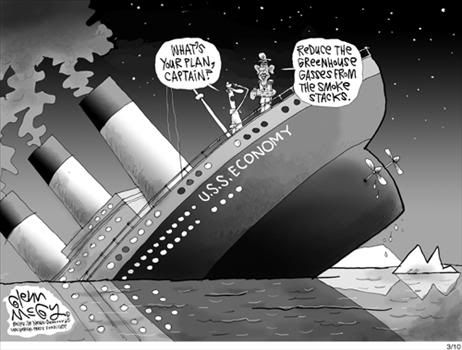
Obamanomics: U.S.S. Economy

Ensign: "For once can't we focus on something besides the environment (tailpipe exhaust), I think we have a much more serious problem, here?"

Labels: , , ,

Wednesday, April 29, 2009

100 Days a Grim Reminder

Obama's 100 days of legacy a grim reminder of the past.
US's Various Shades of the Great Depression Poverty

US President Barack Obama is being compared to former US President Franklin D. Roosevelt, who was a known Nazi financier who not only bankrupted the US in his day to do so; but was a perpetrator with Adolf Hitler that created the Holocaust in Europe with one of the most notorious, barbaric horrendous cases of genocide to ever have occurred in history.

While Americans suffered the most severe poverty, during what was known as the Great Depression; where Roosevelt may have been a great orator towards a New Deal, in reality he cared less for the American welfare. But Nevertheless, Roosevelt bathed in what he considered the luxury persona of the White House; not unlike what the Nazi regime did when they confiscated the finest homes in Europe.

US President Obama looks at a portrait of former assassinated US President John F. Kennedy.

Kennedy was assassinated in Dallas, Texas at 12:30 p.m.(CST), on 22 November 1963; which has been considered by many Americans, as the greatest US governmental (internal) conspiracy in American history.

In 1991, director and producer Oliver Stone made a movie called, "JFK;"apparently with this conspiracy premise, in mind.

Around 600 troops attended the US President's address in Baghdad, Iraq; as the Iraqi genocide within the country continues.
US President Obama greets California Governor Arnold Schwarzenegger (who's family where Austrian Nazi's during WW2) and his wife Maria Shriver before the Governor's Dinner.

Obama Toots His Own Horn

Let’s not forget so soon, of Obama’s over zealousness towards tooting his own horn as far as every facet of the media goes and his public persona; his brashness is most unbecoming.

Labels: , , , , , , , , , ,

Monday, April 6, 2009

"Pay the Bonus"

“Keep the Home Fires Burning;" is the song under the photograph, which was a propaganda tune from World War 1. If one also notices the upper part of the newspaper article header, one will also see that the harshness of segregation or racism between white and black American’s was still being enforced during this time period.

The Bonus March on Washington

The self-named Bonus Expeditionary Force was an assemblage of some 43,000 marchers — 17,000 World War I veterans, their families, and affiliated groups, who protested in Washington, D.C., in spring and summer of 1932. Called the Bonus March by the news media, the Bonus Marchers were more popularly known as the Bonus Army. The war veterans sought immediate cash payment of Service Certificates granted to them eight years earlier via the Adjusted Service Certificate Law of 1924. Each Service Certificate, issued to a qualified veteran soldier, bore a face value equal to the soldier's promised payment, plus compound interest. The problem was that the certificates (like bonds), matured twenty years from the date of original issuance, thus, under extant law, the Service Certificates were un-redeemable until 1945.

The Bonus Army was led by Walter W. Waters, a former Army sergeant, and was encouraged in their demand for immediate cash-payment redemption of their service certificates by retired U.S.M.C. Maj. Gen. Smedley Butler, one of the most popular military figures of the time.

In 1924, over-riding President Calvin Coolidge's veto, Congress legislated compensation for veterans to recognize their war-time suffering: receive a dollar for each day of domestic service, to a maximum of $500; and $1.25 for each day of overseas service, to a maximum of $625. Amounts owed of $50 or less were immediately paid; greater sums were issued as certificates of service maturing in 20 years.

Some 3,662,374 military service certificates were issued, with a face value of $3.638 billion. Congress established a trust fund to receive 20 annual payments of $112 million that, with interest, would finance the $3.638 billion dollars owed to the veterans in 1945. Meanwhile, veterans could borrow up to 22.5% of the certificate's face value from the fund. In 1931, because of the Great Depression, Congress increased the loan value to 50 per cent of the certificate's face value; yet, by April 1932, loans amounting to $1.248 billion dollars had been paid, leaving a $2.36-billion-dollar deficit. Although there was Congressional support for the immediate redemption (payment) of the military service certificates, President Hoover and Republican congressmen opposed that, because it would negatively affect the Federal Government's budget and Depression-relief programs. Meanwhile, veterans organizations pressed the Federal Government to allow the early redemption of their military service certificates.

Bonus Marchers In Washington
Original caption: Bonus March on Washington, July, 1932. Veterans cheer Rep. Fish who was in Favor of bill to pay soldier's bonus, after they were ordered off capital steps.


Bonus Veterans Crouch Beneath Banner
Original caption: 6/19/1932-Washington, DC- "We need cash not a tombstone, pay the bonus now," says the sign these veterans from Muncie, Indiana display. And the Muncie contingent is just one of the many who say they will remain in the capital until the bonus is paid them.


"I was horrified to see plain evidence of hunger in their faces."

Evalyn Walsh McLean was the wife of the owner of the Washington Post and a pillar of Washington Society. She describes the scene as the Bonus Army first entered Washington and marched past her elegant mansion:

On a day in June, 1932, I saw a dusty automobile truck roll slowly past my house. I saw the unshaven, tired faces of the men who were riding in it standing up. A few were seated at the rear with their legs dangling over the lowered tailboard. On the side of the truck was an expanse of white cloth on which, crudely lettered in black, was a legend, BONUS ARMY.

Other trucks followed in a straggling succession, and. on the sidewalks of Massachusetts Avenue where stroll most of the diplomats and the other fashionables of Washington were some ragged hikers, wearing scraps of old uniforms. The sticks with which they strode along seemed less canes than cudgels. They were not a friendly-looking lot, and I learned they were hiking and riding into the capital along each of its radial avenues; that they had come from every part of the continent. It was not lost on me that those men, passing anyone of my big houses, would see in such rich shelters a kind of challenge.

I was burning, because I felt that crowd of men, women, and children never should have been permitted to swarm across the continent. But I could remember when those same men, with others, had been cheered as they marched down Pennsylvania Avenue. While I recalled those wartime parades, I was reading in the newspapers that the bonus army men were going hungry in Washington.

That night I woke up before I had been asleep an hour. I got to thinking about those poor devils marching around the capital. Then I decided that it should be a part of my son Jock's education to see and try to comprehend that marching. It was one o'clock, and the Capitol was beautifully lighted. I wished then for the power to turn off the lights and use the money thereby saved to feed the hungry.

When Jock and I rode among the bivouacked men I was horrified to see plain evidence of hunger in their faces; I heard them trying to cadge cigarettes from one another. Some were lying on the sidewalks, unkempt heads pillowed on their arms. A few clusters were shuffling around. I went up to one of them, a fellow with eyes deeply sunken in his head.

'Have you eaten?' He shook his head.

Just then I saw General Glassford, superintendent of the Washington police. He said, 'I'm going to get some coffee for them.'

'All right,' I said, 'I am going to Childs'.'

It was two o'clock when I walked into that white restaurant. A man came up to take my order. 'Do you serve sandwiches? I want a thousand," I said. "And a thousand packages of cigarettes.'

'But, lady - '

'I want them right away. I haven't got a nickel with me, but you can trust me. I am Mrs. McLean.'

Well, he called the manager into the conference, and before long they were slicing bread with a machine; and what with Glassford's coffee also (he was spending his own money) we two fed all the hungry ones who were in sight.

...One day Waters, the so-called commander, came to my house and said: 'I'm desperate. Unless these men are fed, I can't say what won't happen to this town.' With him was his wife, a little ninety-three-pounder, dressed as a man, her legs and feet in shiny boots. Her yellow hair was freshly marceled.

'She's been on the road for days,' said Waters, 'and has just arrived by bus.'

I thought a bath would be a welcome change; so I took her upstairs to that guest bedroom my father had designed for King Leopold. I sent for my maid to draw a bath, and told the young woman to lie down.

'You get undressed,' I said, 'and while you sleep I'll have all your things cleaned and pressed.'

'Oh, no,' she said, 'not me. I'm not giving these clothes up. I might never see them again.'

Her lip was out, and so I did not argue. She threw herself down on the bed, boots and all, and I tiptoed out.

That night I telephoned to Vice-President Charlie Curtis. I told him I was speaking for Waters, who was standing by my chair. I said: 'These men are in a desperate situation, and unless something is done for them, unless they are fed, there is bound to be a lot of trouble. They have no money, nor any food.'

Charlie Curtis told me that he was calling a secret meeting of senators and would send a delegation of them to the House to urge immediate action on the Howell bill, providing money to send the bonus army members back to their homes."


Arrival in Washington

The Bonus Army massed at the United States Capitol on June 17 as the U.S. Senate voted on the Patman Bonus Bill, which would have moved forward the date when World War I veterans received a cash bonus. Most of the Bonus Army camped in a Hooverville (transit or homeless Camps named after US President Herbert Hoover, well-known during the 1930’s Great Depression) on the Anacostia Flats, then a swampy, muddy area across the Anacostia River from the federal core of Washington. The camps, built from materials scavenged from a nearby rubbish dump, were tightly controlled by the veterans with streets laid out, sanitation facilities built and parades held daily. To live in the camps, veterans were required to register and prove they had been honorably discharged. The protesters had hoped that they could convince Congress to make payments that would be granted to veterans immediately, which would have provided relief for the marchers who were unemployed due to the Depression. The bill had passed the House of Representatives on June 15 but was blocked in the Senate.


Shacks, put up by the Bonus Army on the Anacostia flats, Washington, DC, burning after the battle with the military, 1932.


The U.S. Army intervenes

On 28 July, 1932, Attorney General Mitchell ordered the police evacuation of the Bonus Army veterans, who resisted; the police shot at them, and killed two. When told of the killings, President Hoover ordered the U.S. Army to effect the evacuation of the Bonus Army from Washington, D.C.

At 4:45 p.m., commanded by Gen. Douglas MacArthur, the 12th Infantry Regiment, Fort Howard, Maryland, and the 3rd Cavalry Regiment, supported by six battle tanks commanded by Maj. George S. Patton, Fort Myer, Virginia, formed in Pennsylvania Avenue while thousands of Civil Service employees left work to line the street and watch the U.S. Army attack its own veterans. The Bonus Marchers, believing the display was in their honour, cheered the troops until Maj. Patton charged the cavalry against them — an action which prompted the Civil Service employee spectators to yell, "Shame! Shame!"

After the cavalry charge, infantry, with fixed bayonets and adamsite gas, entered the Bonus Army camps, evicting veterans, families, and camp followers. The veterans fled across the Anacostia River, to their largest camp; President Hoover ordered the Army assault stopped, however, Gen. MacArthur—feeling this free-speech exercise was a Communist attempt at overthrowing the U.S. Government—ignored the President and ordered a new attack. Hundreds of veterans were injured, several were killed — including William Hushka and Eric Carlson; a veteran's wife miscarried; and many other veterans were hurt.

The Posse Comitatus Act — forbidding civilian police work by the U.S. military — did not apply to Washington, D.C., because it is the federal district directly governed by the U.S. Congress (U.S. Constitution, Article I. Section 8. Clause 17). The exemption was created because of an earlier "Bonus March". In 1781, most of the Continental Army was demobilized without pay, two years later, in 1783, hundreds of Pennsylvania war veterans marched on Philadelphia, surrounded the State House wherein Congress was in session, and demanded their pay. The U.S. Congress fled to Princeton, New Jersey, and, several weeks later, the U.S. Army expelled the war veterans back to home, out of the national capital.

An infant, Bernard Myers, later died in the hospital after the incident but reports indicated the death was not caused by the evacuation of the BEF.

Casualties and Losses

All told their where 4 dead and as many as 1,017 marchers and family injured, with at least 69 police injured.

Aftermath

Following his election, US President Franklin D. Roosevelt did not want to pay the bonus early either, but handled the veterans with more skill. In March 1933, Roosevelt issued an executive order allowing the enrollment of 25,000 veterans in the Civilian Conservation Corps for work in forests. When they marched on Washington again in May 1933, he sent his wife Eleanor to chat with the vets and pour coffee with them, and she persuaded many of them to sign up for jobs making a roadway to the Florida Keys, which was to become the Overseas Highway, the southernmost portion of U.S. Route 1. On September 2, the disastrous Labor Day Hurricane of 1935 killed 258 veterans working on the Highway. After seeing more newsreels of veterans giving their lives for a government that had taken them for granted, public sentiment built up so much that Congress could no longer afford to ignore it in an election year (1936). Roosevelt's veto was overridden, making the bonus a reality.


References:

Evalyn Walsh McLean's account appears in: Father Struck it Rich (1936); Daniels, Roger, The Bonus March; an Episode of the Great Depression (1971).

Bonus Army, Wikipedia

Memory: The Bonus Army March, Library of Congress

Labels: , , , , , ,

Wednesday, March 11, 2009

Off the Record: The California Dream

Come to California
There are jobs of plenty
And land is cheap.
Every working man can have his own house and inside every house a happy all-American family.
You can have all this and who knows…you may even be discovered…become a movie star or at least see one.
Life is good in California...It is paradise on earth…that is what they tell you, anyway. Because they are selling and image…they’re selling it through movies, radio and television.


You think California was the Garden of Eden, but the underbelly always has had its serpent, with felony crime, corruption, prostitution and drugs.

Just as the clean fresh face Mid-Western girl’s who got of the bus in plenty, with star’s glittering in their eye’s with the hope of becoming that next big movie star and as far as she ever got on a Hollywood lot of fame and fortune; is some director’s office sofa or ending up along prostitution row, only to die from a drug over-dose, other unmentionables; to ending up on some vacant lot dead, all cut up like Elizabeth Short (The Black Dahlia) and this was her only walk to fame’s headlines of the butchering, with no solid lead of the killer.

A mug shot of Elizabeth Short (The Black Dahlia) by Santa Barbara police, after her arrest for underage drinking, on 23 September 1943; prior to her murder.

Or those fresh faced young men stepping of the bus from who knows where, with the same star twinkles in their eyes and end up a slap boy for some up and coming politician or lawyer; slapped and tickled homosexual play toy. To later, be tossed away on some trumped-up charge like a ‘kiddy rapper beef;’ heading for (San) Quentin or the “Q;” with yet, just the possibility of just getting their throat sliced from ear to ear.

But less we forget, it was all done with champagne luxury style…which in reality until the economic bust, California became one of the most expensive states to live in; other then New York City….so let’s keep this on the GT and very Hush-Hush with the same old tabloid rag.

Places called “Hoovervilles,” named after former US President Herbert Hoover sprang up during the Great Depression as people lost their jobs and homes; besides the shanty towns, there where an overwhelming amount of what was called “transit camp’s,” which many consisted of nothing more then tent cities. In 2009, American’s are living in what is now being termed as “Obamavilles;” after current US President Barack Obama.

Obamaville: The tents and other makeshift homes have sprung up in the shadow of Sacramento's skyscrapers

Today, tents are once again springing up in the city of Sacramento. But this time it is for people with no hope and no prospects.


Obamaville: The tent city is already home to dozens of people, many left without jobs because of the credit crunch

Those who have lost their jobs and homes and have nowhere else to go are constructing makeshift shelters on the site, which covers several acres.

As many as 50 people a week are turning up and the authorities estimate that the tent city is now home to more than 1,200 people.

In a state more known for its fantastic wealth and the glitz and glamour of Hollywood, the images have shocked many Americans.

Conditions are primitive, with no water supply or proper sanitation.

Many residents have to walk up to three miles to buy bottled water from petrol stations or convenience stores.

Obamaville: Ben Cardwell, carries supplies to his tent at a homeless settlement

Obamaville: Tammy Day, a homeless woman, cooks potatoes on a campfire at the site

At other times, charity workers arrive to hand out free food and other supplies.

Joan Burke, who campaigns on behalf of the homeless, said the images of Americans living in tents would shock many.

'It should be an eye- opener for everybody,' she said. 'But we shouldn't just be shocked, we should take action to change things, because it's unacceptable.

'It is unacceptable that in this day and age we have gone back to a situation like we had during the Great Depression.'
Obamaville: Keith and Tammy Day cook dinner

Authorities in Sacramento, where Governor Arnold Schwarzenegger, who's family in Austria where of the Nazi Party at Adolph Hitler’s height of in fame; at his office, admit the sight of families living in such poverty is not pretty.

The city's mayor Kevin Johnson said: 'I can't say tent cities are the answer to the homeless population in Sacramento, but I think it's one of the many things that should be considered and looked at.'

Foreclosure rates last year rocketed by 327 per cent, with up to 500 people a day losing their home.

Coupled with massive job cuts that have seen one in ten workers laid off, many people who once enjoyed a middle class existence are now forced into third world conditions.

Former car salesman Corvin and his wife Tena are among the newest residents of the tent city.
Obamaville: Tent city residents queue up to receive supplies handed out by a local charity
The couple, who are in their fifties, lost their home and jobs around the same time.

With homeless shelters full in Sacramento, they had little choice but to use what savings they had left to buy a tent.

The couple admit they have yet to tell their grown-up children about their hand-to-mouth existence.

Tena said: 'I have a 35-year-old son, and he doesn't know. I call him, about once a month and on holidays, to let him know that I'm well and healthy.
Many of those who have found themselves homeless worked in the building trade.

But with no new home builds and as many as 80,000 people losing their job every month, there is little chance of employment.

'He would love me anyway, but I don't want to worry him.'

US President Barack Obama jaunts jubilantly on stage as he arrives to speak about education at the 19th Annual Legislative Conference of the United States Hispanic Chamber of Commerce in Washington, 10 March 2009. The song under the photograph above was called. “Where in the Money,” which came out in 1933 as a propaganda tune in retrospect as a mockery of how dire the condition’s actually where during the Great Depression. The song was first featured in the film called; “The Gold Digger’s of 1933” and was presented by a chorus line of scanty dressed women.

As these tent cities will continue to grow in the weeks, months and years ahead with no prosperity in sight. US President Barack Obama’s previous stimulus package fund’s finding its way out of the country for such thing’s as there terrorism genocide increase and troop build-up in Afghanistan or to fund various military contracts for their global initiatives on they’re domination projects for example or for such pet projects as $1.8 million for swine odor and manure management research in Iowa, $2 million to promote astronomy in Hawaii and $381,000 for music programs at New York City’s Lincoln Center.

But yet, the American people have to stand and wait and wonder what sorrows will still becoming there way, as the poverty problem continues to balloon somewhere out past the stratosphere.

Update:

13 March 2009

As to the Obamaville’s in Sacramento which are seen in the above photograph's, it has been reported while these camps are acquiring 50 to 100 people a day with no other place to live or no other foreseeable place to go; that US President Barack Obama’s solution for these particular camps was to order the city of Sacramento to evict all these tent resident’s from their present location.

As to the present living conditions which are deployable and unsafe health hazard with no sanitation or water for instance and having to in most instances to cook over dug holes made into a type of grill to cook what ever a person can"hope to find," instead of Obama helping these American’s; he has found a way to increase their misery.

These camps are also being considered worse, than any fourth world country.

Nevertheless, as to the US commenting of being a safe investment in the world, is nothing but arrogance; as the country plummet’s further into despair.

Labels: , , , , , , , , , ,

Thursday, March 5, 2009

“The Bank Owns It”

In this 23 February 2009 file photo, a bank owned sign blows in the wind in front of a home; in Antioch, California.

During the 1930’s Great Depression with the overwhelming amount of foreclosures of not just homes, but farms; it became as a deluge of hardship for the banking system along with financial runs by customer’s to the point; that it was common to see a closed sign on a bank that had failed.

The phrase, “The Bank Owns It;” was a common thing said during the 1930’s Depression as a former owner stood outside there yard because it became illegal to enter his former property, in part because of the sorrow of the former homeowner or a passerby damaging the property as it lay silent for no one could afford to claim or buy the property with the overwhelming amount of unemployment and no one had a dime.

This was also during the time that the American Nazi Parties where on the Adolph Hitler “goose-step” march, as such people as former US President Franklin D. Roosevelt was not just financing the “Final Solution;” along with Prescott Bush (grandfather to former US President George W. Bush), with many others giving the Nazi global domination handshake and waving the 'iron' flag at rallies.

Jewish Holocaust, also known as “Final Solution”

Then as the US government plummeted deeper into the financial and political global domination devastating destruction Jewish Holocaust abyss; we got the propaganda version about face; of World War two.

As the United States in 2009, stands at the threshold of this stand still of that time of ‘dust bowl tears;’ as a forgotten home owner see’s his lost home being racked with the weather and to say, “The bank owns it!”

As always, the US is on the march bankrupting their own country and the world, as the death toll globally continues to climb into triple digit record numbers; as the Jewish and Islamic people watch the death viewed around them from the US strangling grip and the global community watches the bread being grabbed from there very mouth‘s, by US Uncle Sam's hands.

Labels: , , , , , , , , , , ,

Wednesday, February 18, 2009

Guadeloupe Economic Riot

A man looks at the burned remains of a car after rioting over the rising cost of living on the Caribbean island of Guadeloupe. The tiny island state has been gripped by month-long strikes; due to the depressive economic conditions similar to what is occurring in the United States; on 17 February 2009.

The riot was due to the people of this country, wishing better conditions, such as rise in employment pay and lower living cost's; that has been apparently strangling the citizen’s of Guadeloupe, just trying to survive from day to day.

But yet the demonstrator’s are still bound by the ties of slavery, thought long forgotten; as it continues to raise its head like a cobra, with blood stained fangs.

Further Reading:

French riot police arrive in Martinique

Anti-riot police to be sent to Martinique, French minister returns to Guadeloupe

Labels: , , , ,

Friday, February 6, 2009

US Sapping the Blood of Increase Unemployment

In this 2 January 1974 file photo, people are shown as they sell blood in an Atlanta laboratory.

Blood donors for pay have increased considerably in recent months as unemployment has risen. Economic battered employers eliminated 598,000 jobs in January 2009, the most since the end of 1974 as said by some economist and has catapulted the unemployment rate to 7.6 percent; which lacks the 2 percent margin that was considered the bench mark for the unemployment rate of the 1930’s Great Depression.

With yet more turbulent economic seas yet ahead, as the US economy continues to plummet with no end in sight and no foreseeable manner of return. Even US President Barack Obama’s underhanded moves to force his latest stimulus package, will not save the US economy from falling deeper into the economic pit.

Labels: , , , , ,

Friday, January 30, 2009

On second thought, never mind about that bailout

A man holds a sign with the words: "Need Food For Family, God Bless You, Will Work," at an intersection in Miami, Florida. US lawmakers are set to hand Barack Obama the first major win of his week-old presidency, overriding chiefly Republican objections to pass a highly questionable $825bln economic stimulus plan.

30 January 2008
By
MATT APUZZO

WASHINGTON – A small but growing number of community banks are backing out of the government's bailout, which they see as fraught with hidden strings and government interference.

About 20 banks so far that applied for or had been approved to receive about $1 billion combined in taxpayer money have reversed course in the past month and refused to take the money. That's just a fraction of the hundreds of billions of dollars the government already has spent, but it shows that taxpayers aren't the only ones anxious about the financial bailout.

"The government's going to own a good portion of these banks," said David Heintzman, president of Stock Yards Bank & Trust in Louisville, Ky. The bank recently turned down $43 million in approved bailout money.

After Congress approved the $700 billion bailout in October, the government gave banks only a few weeks to decide whether they wanted to take part in the government investment program. Many applied to get a foot in the door, in case predictions of an economic collapse came true.

"We drank the Kool-Aid," said Michael Ross, president of Fidelity Bank in Dearborn, Mich., which applied for about $29 million in November.

But as details emerged, the deal didn't look so good. For Fidelity, taking the money would mean the government would have owned about 25 percent of the company's outstanding stock. Then Congress and the White House could start calling the shots, Ross said. He remembers the government's failure overseeing Freddie Mac and its sister company, Fannie Mae, the two housing companies so badly mismanaged they were taken over by the Bush administration.

"These are the guys who brought you Hurricane Katrina. These are the guys who were supposed to be watching Fannie and Freddie," Ross said. "I've not seen anything like this, where they really are talking about nationalizing banks."

Much of the criticism about the bailout has focused on the lack of oversight, which allowed banks to take money and refuse to say where it's going. Wall Street executives, who make millions of dollars and enjoy lavish perks like private jets, earned the ire of consumer watchdogs who said taxpayers were getting a raw deal.

But some community banks, which had little or nothing to do with the subprime mortgage crisis, say the deal didn't look great for them, either.

Congress wants banks to make loans, so businesses can expand and people can start buying houses again. But lawmakers also want them to make only trustworthy loans. But there are only so many good loans to make in a weak economy with high unemployment.

Explaining that to investors is easy. To politicians, it might looks like you're hoarding taxpayer money.

"Then what? Then they have a guy at our board meeting?" said William Campbell, president of Pamrapo Savings Bank, a Bayonne, N.J., bank that walked away from its $11 million bailout application.

The government also can force banks to cut dividends to shareholders, making a bank's stock less attractive to investors. President Barack Obama has said he wants to prohibit banks from buying other banks. And at any time, Congress can change the law and add new terms.

"Are you going to enter into a contract that will cost you millions of dollars if you can't live with the rules and you don't even know what the rules are?" said Steve Buster, CEO of Richmond, Calif.-based Mechanics Bank, which refused $60 million in bailout money. "I don't know of any other forum that parties can change the contract at will. This is not fair."

The banks that turned down the money said they were comfortable their own finances will allow them to weather the storm. For some, taking the money seemed riskier than turning it down.

"We finally said, 'Hey do we really want to go down this path?'" said Michael Blodnick, chief executive of Glacier Bancorp of Kalispell, Mont. "I understand a lot of banks do, and a lot of banks need to."

Labels: , , , ,

Thursday, January 29, 2009

US Continues Economic Implosion

Job seekers queue up to attend a job fair 27 January 2009, in Chicago. The number of people receiving unemployment benefits has reached an all-time record, the government said Thursday, and more layoffs are spreading throughout the economy.


The Labor Department reported that the number of Americans continuing to claim unemployment insurance for the week ending 17 January was a seasonally adjusted 4.78 million. That's an increase of 159,000 from the previous week and worse than economists' expectations of 4.65 million.

The total released by the department doesn't include about 1.7 million people receiving benefits under an extended unemployment compensation program authorized by Congress last summer. That means the total number of recipients is actually closer to 6.5 million people.

With further momentous job cut’s in the near future as the US economic situation further implodes into a deeper depression.

As it is not also forgotten, that consumer spending is further dropping as American’s continue seeing the sliding economic downfall.


As to US President Barack Obama’s current idea of a stimulus package to shore up the problem is in the works, as it is put across in the media; apparently he has not learned anything from his predecessor or from the history of his own country.

Labels: , , ,

US Postmaster General: Mail days may need to be cut

U.S Postmaster General John Potter takes note on Capitol Hill in Washington, on 28 January 2009; while testifying before the Senate Governmental Affairs subcommittee.

28 January 2008

WASHINGTON – Massive deficits could force the post office to cut out one day of mail delivery, the postmaster general told Congress on Wednesday, in asking lawmakers to lift the requirement that the agency deliver mail six days a week.

If the change happens, that doesn't necessarily mean an end to Saturday mail delivery. Previous post office studies have looked at the possibility of skipping some other day when mail flow is light, such as Tuesday.

Faced with dwindling mail volume and rising costs, the post office was $2.8 billion in the red last year. "If current trends continue, we could experience a net loss of $6 billion or more this fiscal year," Postmaster General John E. Potter said in testimony for a Senate Homeland Security and Governmental Affairs subcommittee.

Total mail volume was 202 billion items last year, over 9 billion less than the year before, the largest single volume drop in history.

And, despite annual rate increases, Potter said 2009 could be the first year since 1946 that the actual amount of money collected by the post office declines.

"It is possible that the cost of six-day delivery may simply prove to be unaffordable," Potter said. "I reluctantly request that Congress remove the annual appropriation bill rider, first added in 1983, that requires the Postal Service to deliver mail six days each week."

"The ability to suspend delivery on the lightest delivery days, for example, could save dollars in both our delivery and our processing and distribution networks. I do not make this request lightly, but I am forced to consider every option given the severity of our challenge," Potter said.

That doesn't mean it would happen right away, he noted, adding that the agency is working to cut costs and any final decision on changing delivery would have to be made by the postal governing board.

If it did become necessary to go to five-day delivery, Potter said, "we would do this by suspending delivery on the lightest volume days."

The Postal Service raised the issue of cutting back on days of service last fall in a study it issued. At that time the agency said the six-day rule should be eliminated, giving the post office, "the flexibility to meet future needs for delivery frequency.

A study done by George Mason University last year for the independent Postal Regulatory Commission estimated that going from six-day to five-day delivery would save the post office more than $1.9 billion annually, while a Postal Service study estimated the saving at $3.5 billion.

The next postal rate increase is scheduled for May, with the amount to be announced next month. Under current rules that would be limited to the amount of the increase in last year's consumer price index, 3.8 percent. That would round to a 2-cent increase in the current 42-cent first class rate.

The agency could request a larger increase because of the special circumstances, but Potter believes that would be counterproductive by causing mail volume to fall even more.

Dan G. Blair, chairman of the Postal Regulatory Commission, noted in his testimony that cutting service could also carry the risk of loss of mail volume. He suggested Congress review both delivery and restrictions it imposed on the closing of small and rural post offices.

The post office's problem is twofold, Potter explained.

"A revolution in the way people communicate has structurally changed the way America uses the mail," with a shift from first-class letters to the Internet for personal communications, billings, payments, statements and business correspondence.

To some extent that was made up for my growth in standard mail — largely advertising — but the economic meltdown has resulted in a drop there also.

Potter also asked that Congress ease the requirement that it make advance payments into a fund to cover future health benefits for retirees. Last year the post office was required to put $5.6 billion into the fund.

"We are in uncharted waters," Potter said. "But we do know that mail volume and revenue — and with them the health of the mail system — are dependent on the length and depth of the current economic recession."

He proposed easing the retirement pre-funding for eight years, while promising that the agency will cover the premiums for retirement health insurance.

At the same hearing the General Accounting Office agreed that the post office is facing an urgent need for help to preserve its financial strength. But the GAO suggested easing the pre-funding requirement for only two years, with Congress Boldto determine the need for more relief later.

Potter noted that the agency has cut costs by $1 billion per year since 2002, reduced its work force by 120,000, halted construction of new facilities except in emergencies, frozen executive salaries and is in the process of reducing its headquarters work force by 15 percent.

___

On the Net:

U.S. Postal Service:
http://www.usps.com

Labels: , , ,

Wednesday, January 7, 2009

State unemployment claim systems overwhelmed

Photograph of Unemployed Workers Marching in New Jersey During the Great Depression.


6 January 2008
By
RICHARD RICHTMYER

ALBANY, N.Y. – Electronic unemployment filing systems have crashed in at least three states in recent days amid an unprecedented crush of thousands of newly jobless Americans seeking benefits, and other states were adjusting their systems to avoid being next.

About 4.5 million Americans are collecting jobless benefits, a 26-year high, so the Web sites and phone systems now commonly used to file for benefits are being tested like never before.

Even those that are holding up under the strain are in many cases leaving filers on the line for hours, or kissing them off with an "all circuits are busy" message. Agencies have been scrambling to hire hundreds more workers to handle the calls.

Systems in New York, North Carolina and Ohio were shut down completely by technical glitches and heavy volume, and labor officials in several other states are reporting higher-than-normal use.

"Regardless of when you call, be prepared to wait and just hang on. Try not to get frustrated," said Howard Cosgrove, a spokesman for the Wisconsin Department of Workforce Development, which boosted its staff of telephone operators by 25 percent last month to cope with a phone system that has been overloaded for weeks. "We sympathize, we're on their side, we're doing our best to help them out."

The nation's unemployment rate in November zoomed to 6.7 percent, a 15-year high. Economists predict it will rise to 7 percent in December, with another 500,000 jobs probably cut last month. The government releases its monthly employment report on Friday.

Some states attribute the increase in call volume in part to an extension of federal emergency unemployment compensation from 13 weeks to 20 weeks in late November. More than 54,000 Pennsylvanians had exhausted their federal benefits after 13 weeks by the time that occurred, said David Smith, a spokesman for the Pennsylvania Department of Labor and Industry.

"It really was a perfect storm," he said.

New York's phone and Internet claims system started to buckle on Monday afternoon and was out of service completely for the first half of Tuesday while as many as 10,000 people per hour tried to get in, said Leo Rosales, a state Labor Department spokesman.

Although that was an unusually high number of calls, Rosales said it was a software glitch in an authentication system used to verify filers' identities that caused the system to crash.

"It's designed to handle this volume of calls, but the authentication process didn't work as it should have," he said. Rosales said the glitch that caused the shutdown has been fixed, and the agency doesn't expect any more problems.

About 256,000 people are collecting unemployment in New York, up from about 184,000 at this time last year.

North Carolina's Web site crashed twice this week under a rush of claims as that state set one-day records for both the amount of benefits paid and the number of transactions.

On Sunday and Monday, the number of North Carolinians trying to sign up online for new or continuing benefits was about triple what it was before the economic slowdown started, according to the state Employment Security Commission. That volume, together with a phone line problem, overwhelmed the agency's computers and prevented some people from filing claims.

The system was working again by Monday afternoon after the agency added another server and demand decreased, officials said.

"Right now, everything is back to normal," agency spokesman Larry Parker said.

Mark Turner, 39, of Raleigh said Tuesday that North Carolina's site had an easy setup when he started using the site after he was laid off in November.

But on Sunday, he couldn't logon to the site. "I basically gave up for the night at 10:30 after trying and not getting through," he said Tuesday. "Once you get on the site, you can be done in half a minute. Apparently that was too much."

Turner, who's since landed a temporary job, suggested the site separate people trying to get recertified and people signing up for the first time. "I think it's going to get worse before it gets better," he said.

Thousands were unable to get through to Ohio's unemployment hot line beginning Monday because of a crush of callers and technical problems, said Dennis Evans, spokesman for the state Department of Job and Family Services. He said the phone system was running normally again Tuesday afternoon, but the section of the state's Web site that enables people to make claims online remained down.

California has seen a record number of calls to an 800 number over the last few weeks.

"During this holiday period we've been averaging a record of more than 2 million call attempts a day, and it took more than 20 times before people could get through to our UI call centers," said Employment Development Department spokeswoman Patti Roberts.

That's about twice the one-day record of call attempts set in 2004 during an earlier recession, she said.

Callers to Michigan's main phone line handling applications for jobless benefits got an "all circuits are busy now" message Tuesday afternoon. Officials in Michigan, which had the nation's highest jobless rate at 9.6 percent in November, recently began urging applicants to seek benefits through a state Internet site instead. Michigan counted about 473,000 people as unemployed in November, up from about 370,000 a year ago.

Unemployment agencies from Kentucky to Alaska also are reporting long hold times for callers and slowdowns for those filing online because of higher volume.

Several states have added staff to their call centers to handle the surge, including Ohio, Oklahoma and Washington.

Pennsylvania has hired temporary workers and expanded the hours of its unemployment benefits hot line to accommodate a surge in the number of calls, going from 600 employees to more than 800. Officials hope to eventually have 1,100 workers answering calls.

New Mexico has extended call-center hours, upgraded the phone system and added 15 workers. Even so, "We still are receiving reports of people's inability to get through," said Carrie Moritomo, a spokeswoman for the state Department of Workforce Solutions.

In Kentucky, where claims rose to 40,400 in November from 23,400 a year earlier, a flood of new filers overwhelmed the state's unemployment Web site and phone lines on Monday, when more than 8,000 people filed initial claims, said Kim Brannock, a spokeswoman for the Kentucky Education Cabinet, which oversees the state unemployment office.

"People seem to feel like they have to file first thing Monday morning," she said. "They don't have to, but they feel that way. It's just overwhelming to the system."

Commentary:


The unemployment rate was estimated at it’s highest over 7 percent, but the major consensus that it actually did not reach 8 percent during the 1930’s Great Depression; which was spoke of as such from American’s who had lived through this time and recorded by some historians.

Those seeking employment during this time, often times would form extremely long lines lasting for several blocks or could be succumbed out of desperation into violence. Especially, if workers thought their where several job’s at a particular place, when there may only have been a handful; for example of one case of five.

As the United States stand’s pass the threshold into 2009, the unemployment situation doesn’t seem to see an actual glimmer of easing; but more of a darkening repeat of the past disquietedness.

The ratio percentage of unemployed from the 1930’s to the current 2009 is quite similar and usually show’s the actual state of an economy.

Further Reading:

Continuing Jobless Claims Rise More Than Expected

Labels: , , , ,